14mm vs 16mm pickleball paddle: which thickness suits your game
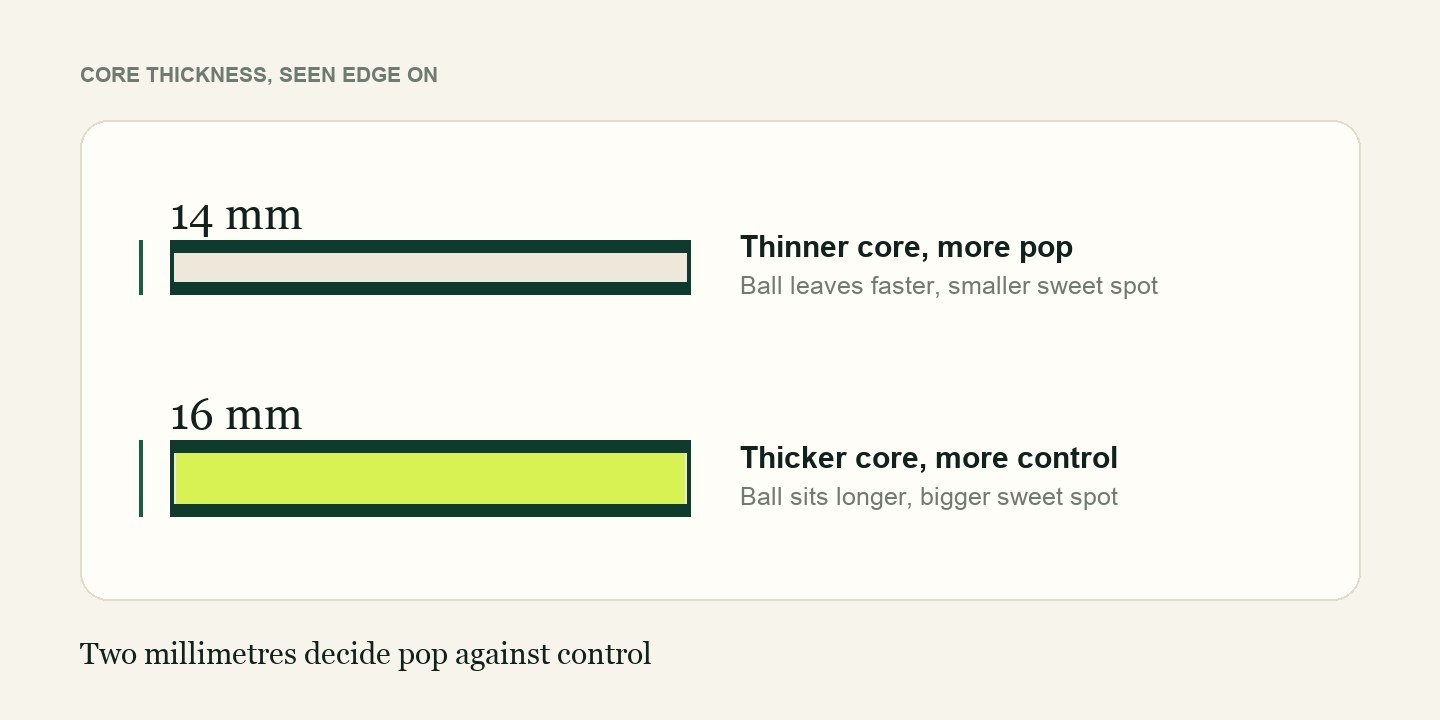
Walk into any paddle listing and you will see two numbers over and over: 14mm and 16mm. They refer to the thickness of the honeycomb core sandwiched between the two faces, and they are the single biggest driver of how a paddle feels. Everything else — face material, shape, weight — sits on top of that choice.
What the two millimetres actually change
A thicker core compresses more on contact. The ball stays on the face fractionally longer, which gives you more feel and a more forgiving sweet spot, and it damps the vibration that makes off-centre hits feel dead. A thinner core does the opposite: less compression, faster rebound, more raw pop.
That is genuinely the whole mechanism. Marketing language dresses it up, but a 16mm paddle is a control paddle and a 14mm paddle is a power paddle, and the two millimetres between them are doing the work.
When 16mm is the right answer
- You spend most of a game at the kitchen line and want your dinks to sit down.
- You want a bigger sweet spot because you are still finding the middle of the face.
- You have any history of tennis elbow — the extra core damps shock noticeably.
- You already generate your own power and keep hitting the ball out.
This is why most players who move past a starter set end up on 16mm. The Vatic Pro Prism 16mm (on Amazon) is a thermoformed example with foam-injected walls, which stiffens the perimeter and pushes the sweet spot outward.
When 14mm is the right answer
- You play mostly singles, or a driving, transition-heavy doubles game.
- You are a smaller or slower swinger who needs help getting depth on drives.
- You want the ball off the face quickly for hand battles at the net.
- You are confident about hitting the middle of the paddle consistently.
A 14mm carbon face like the VUFOXT carbon set (on Amazon) gives you that quicker rebound in a two-paddle pack, which is a cheap way to try the thinner core without committing.
Thickness is not the same as spin
People conflate the two constantly. Spin comes from the face — the texture of the raw carbon or fiberglass and how long it grips the ball — not from the core. A textured 14mm paddle can out-spin a smooth 16mm one and vice versa. If spin is what you are chasing, read our piece on what actually creates paddle spin and look at multi-layer faces like the TENVINA T700 (on Amazon).
How thickness interacts with weight
A 16mm core usually adds a little static weight over the same paddle in 14mm, but the difference is small — often under half an ounce. Swing weight matters far more than that, and it is driven by where the mass sits, not by the core. Our guide to paddle weight covers that properly. If you want to fine-tune it after buying, tungsten tape (on Amazon) lets you add weight to the head or handle without using lead.
So which should you buy
If you genuinely cannot decide, buy 16mm. The forgiveness is worth more to most rec players than the extra pop, and it is much easier to add power to a control paddle — with weight, with technique — than to add control to a paddle that launches everything long.
If you have played for a while, already hit the middle reliably, and your complaint is that balls land short, 14mm is the honest answer.
A note on standards
Both thicknesses are legal for sanctioned play. Paddle specifications, including surface roughness limits, are set by USA Pickleball, and the professional tours — the PPA Tour and Major League Pickleball — run to the same equipment list. Any paddle marked USAPA approved is fine in either thickness.
Compare current options in the paddles section of the store, or start with what to buy first if this is your opening paddle.