Pickleball Rules: How to Play Pickleball (Complete Beginner’s Guide)
Pickleball rules start with an underhand serve, a bounce on each side before volleys, and no volleying in the kitchen. Standard games usually go to 11, won by two. Serve diagonally, keep the ball in bounds, and score on your serve in traditional play.
You don’t need to memorize a rulebook before your first game. You need to know where to stand, when to wait, and what those three score numbers mean. This guide walks you through a rally, explains the kitchen, and gives you a scoring example you can try with friends.
Rules current as of the 2026 USA Pickleball rulebook. Last updated: September 23, 2026. Rule source throughout: USA Pickleball Official Rulebook. This guide covers standard standing play; Section 25 provides wheelchair and adaptive variations.

What Is Pickleball?
What is pickleball? It’s a paddle sport combining elements of tennis, badminton, and table tennis. You hit a perforated plastic ball over a low net, playing singles, one person per side, or doubles, two per side. A rally is the exchange that starts with a serve and ends when play stops. USA Pickleball describes these basics in its rulebook overview.
I’d start with doubles. Sharing the court leaves you more attention for timing and positioning, and less for chasing every ball yourself. Your first goal is simple: keep a cooperative rally going.
Equipment You Need
Your basic equipment is a pickleball paddle, a perforated ball, and a correctly installed net.
Choose a paddle you can hold comfortably without squeezing hard. Borrow one before buying if your rec center has loaners. Our best pickleball paddles guide explains what to compare, while our pickleball set guide covers bundles.
Bring court shoes, water, and a spare ball. Those are practical suggestions, not extra scoring rules. USA Pickleball’s equipment requirements appear in Section 3; check its approved equipment lists when entering sanctioned competition.
The Pickleball Court
A standard court measures 20 × 44 feet for both singles and doubles. The net is 36 inches high at the sidelines and 34 inches at the center. USA Pickleball allows a quarter-inch tolerance for both heights. A 7-foot non-volley zone extends from each side of the net.
The baseline is the back boundary; the sidelines are the side boundaries. The centerline divides each back section into two service courts, where serves land. The non-volley zone is nicknamed the kitchen. Its boundary lines belong to the kitchen.
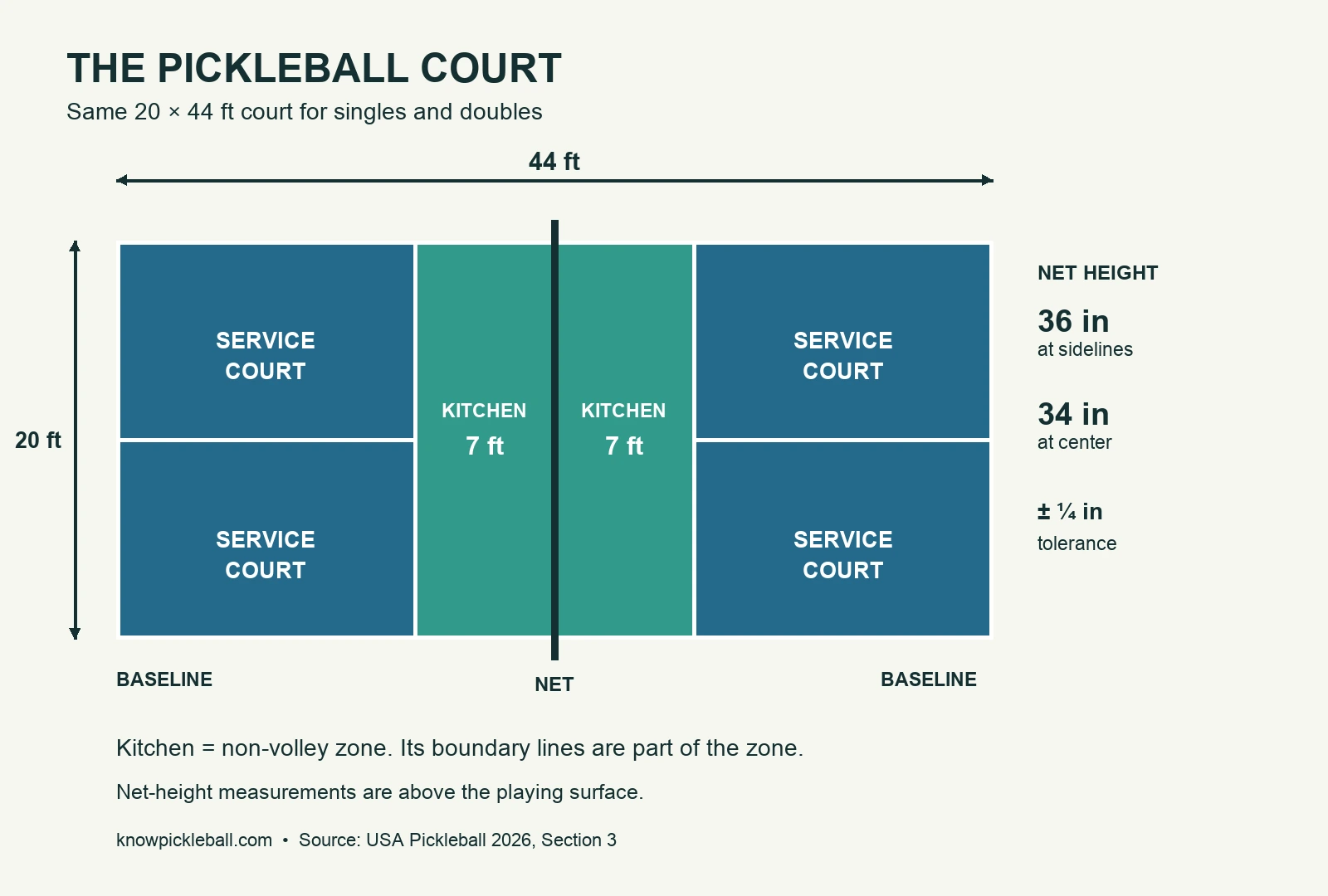
Before playing, walk from the baseline to the kitchen line. Notice that the centerline stops there. During an ordinary rally, you can hit across the centerline into either half of your opponents’ court.
Source: USA Pickleball, Rules 3.A.1, 3.A.4 and 3.B.6–7. See our court dimensions guide for setup details.
How to Play Pickleball: A Rally Step by Step
Here’s how to play pickleball using standard doubles and traditional scoring. A volley means hitting the ball before it bounces. A fault is a rule violation that ends the rally.
- Get ready. Start with the server behind the right baseline and the receiver diagonally opposite. The server’s partner should also stay back to prepare for the return.
- Call the score. Begin at “zero-zero-two.” Finish the entire call before serving. We’ll unpack the final number below.
- Serve diagonally. Send the ball beyond the kitchen into the opposite service court. Use a legal volley serve or drop serve.
- Let the serve bounce. The receiver waits for that bounce, then returns the ball across the net. A comfortable target is deep and toward the middle.
- Let the return bounce. Your serving team must wait too. Either you or your partner can hit this next shot.
- Continue the exchange. With both required bounces completed, you can volley from outside the kitchen or play after one bounce.
- Finish and update. Suppose your opponent hits out. Your serving team wins a point; switch serving sides and call “one-zero-two.”
On your first practice rally, say “bounce” aloud at steps four and five. I’d slow the whole sequence down before adding speed. Two calm bounces are more useful than one spectacular, illegal put-away.
Source: USA Pickleball, Sections 4–7 and Rule 10.A.
Pickleball Rules Explained
Serving Rules
Serving rules govern your starting position, ball release, paddle action, and the diagonal court your serve must reach.
With a volley serve, you strike the released ball before it bounces. At contact, your paddle must travel in an unmistakably upward arc. Its highest point cannot be above the top of your wrist joint, and contact cannot be above your waist. These positions must be clear under USA Pickleball Rules 7.C.1–3.
A drop serve means releasing the ball, letting it bounce, then hitting it. Drop from an unaided height without throwing it up, pushing it down, or propelling it sideways. The volley serve’s three contact restrictions don’t apply. Rule 7.D also permits more than one bounce before you strike the serve.
For either method, keep at least one foot grounded behind the baseline at contact. Neither foot may touch the baseline or court. Any grounded foot must stay within the imaginary extensions of the correct sideline and centerline. These are USA Pickleball’s serving-area requirements, Rules 7.A.1–3.
You get one serve attempt, not tennis-style first and second serves. Specific rule-authorized replays are separate exceptions. Let the receiver see your release, and don’t add spin before striking; paddle-generated spin at contact is permitted under Rule 7.B.
A diagonal serve must clear the kitchen, including its line, and land in the proper service court. There are no service lets. If your serve clips the net and lands correctly, keep playing. USA Pickleball Rule 7.E explicitly allows net contact.
I’d choose a simple drop serve if coordinating the release and swing feels awkward. Aim several feet inside the service box. The sideline will still be there when you’re more confident.
The Two-Bounce Rule
The two-bounce rule means the serve and its return must each bounce before either is hit back.
That’s one bounce on the receiving side, then one on the serving side. It does not mean two bounces on your side. After those opening shots, volleys become available subject to the kitchen rule.
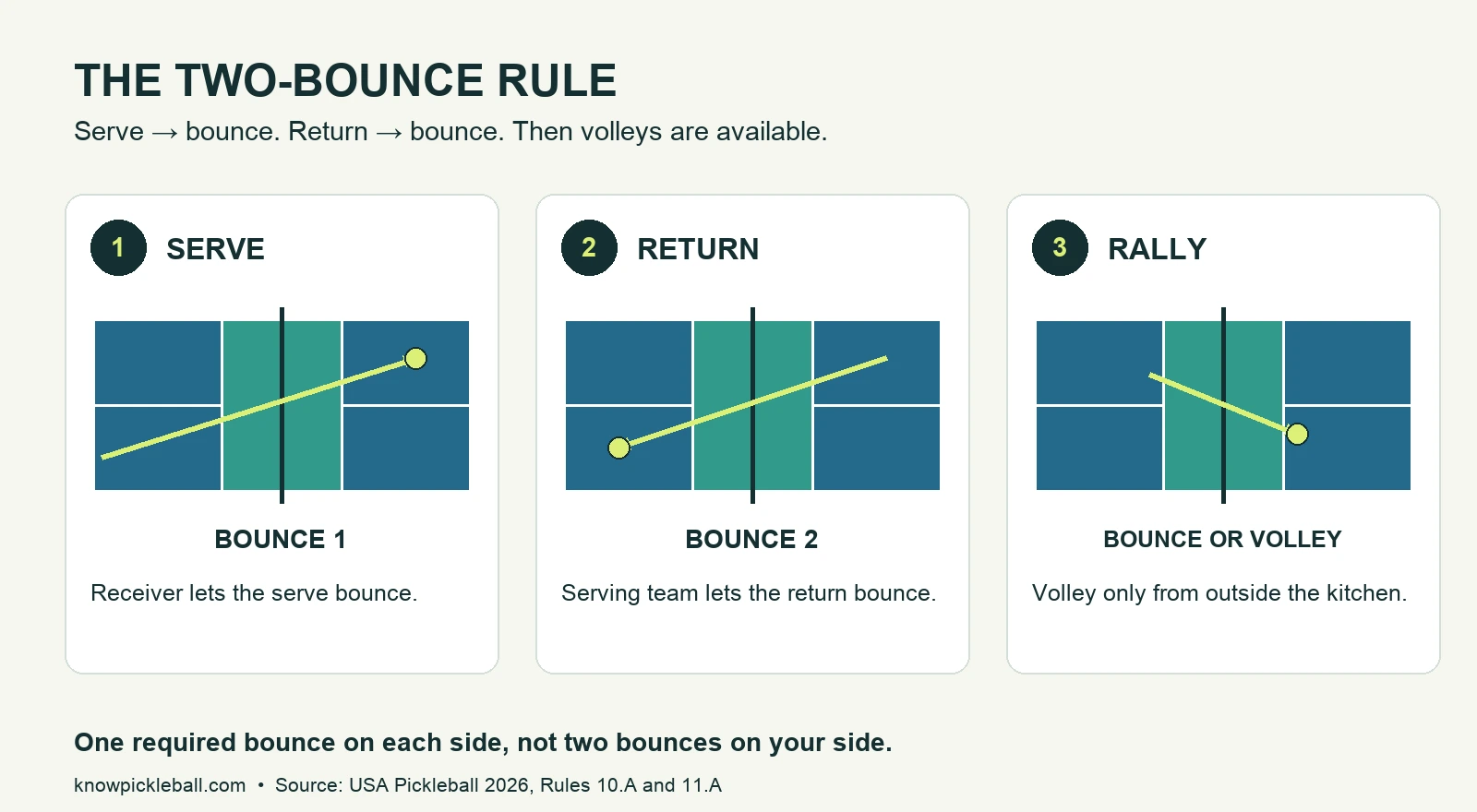
Picture your partner serving while you stand near the kitchen line. The return comes straight at your feet. Resist the easy volley: your team still owes a bounce. Starting beside your partner near the baseline makes that choice easier.
Source: USA Pickleball, Rule 10.A. Standard maximum-bounce rule: 10.B.
The Kitchen (Non-Volley Zone) Rule
The kitchen rule prohibits contact with the non-volley zone during a volley, including contact caused by your follow-through momentum.
You may stand in the kitchen whenever you like, provided you aren’t volleying. You can enter before the ball bounces. You can stay there after hitting a bounced ball. The painted area isn’t lava.
A dink is a soft shot played after a bounce that lands in the opponents’ kitchen. When a short ball draws you forward, step in and play it. I’d practice that move slowly, then recover outside the line with both feet.
After touching the kitchen, both feet must contact the surface entirely outside it before your next volley. Jumping from inside the kitchen and contacting the ball while airborne doesn’t solve the problem.
Momentum is the movement continuing from your volley. If that movement carries you onto the kitchen line, you’ve faulted, even after the rally otherwise ends. Your paddle, clothing, or contact with a partner standing in the zone can also create a fault. Finish balanced before relaxing.
Source: USA Pickleball, Rules 11.A–11.A.3 and the act-of-volleying definition. More examples: kitchen rules.
Line Calls
Line calls determine whether a ball lands in bounds; boundary lines are in, except the kitchen line on a serve.
A serve touching the correct service court’s centerline, sideline, or baseline is good. A serve touching the kitchen line is a fault. During later shots, a ball landing on any court line is in.
In recreational play, call your own end honestly and promptly. Only call “out” when you clearly see space between the ball and the line at landing. Uncertainty favors your opponent. If doubles partners disagree, the ball is in.
If you return the ball, call out before the opponent hits it or the ball becomes dead. A dead ball is no longer in play. If you don’t return it, your call still must be prompt, even when the ball has just become dead.
Source: USA Pickleball, Rules 8.A–8.H, especially 8.F.3.
Common Faults
Common faults are violations that stop the rally and give its outcome to the opposing player or team.
- ☐ Serving into the kitchen, onto its line, or outside the proper diagonal box. USA Pickleball: 7.E.1–2.
- ☐ Volleying the serve or its return before the required bounce. USA Pickleball: 10.A.1–2.
- ☐ Letting an ordinary rally ball bounce twice before returning it. USA Pickleball: 10.B.1.
- ☐ Hitting out, or into the net so the ball lands on your side. USA Pickleball: 10.C.1–2.
- ☐ Touching the kitchen during a volley or through its momentum. USA Pickleball: 11.A.1–3.
- ☐ Having you and your partner both hit the same return. USA Pickleball: 10.D.2.
- ☐ Touching the net while the ball remains live. USA Pickleball: 13.G.1.
Losing a rally doesn’t always mean your opponents gain a point. That depends on which scoring system you chose.
How Scoring Works
Pickleball scoring feels easier once you separate two questions: who won the rally, and who was serving? In traditional play, those answers determine whether the score changes or the serve moves.
Side-Out Scoring and Calling the Score
Side-out scoring awards points only to the serving side, and a side-out transfers service to the opponents.
In doubles, call your team’s score, their score, then the server number. That final number is 1 or 2 for the current service turn. It isn’t a permanent player label.
The opening team gets just one server for its first turn. That player starts as server 2, which explains 0-0-2. After that opening turn, each team normally gets both servers before a side-out.
Try this sequence with you and Maya against Ben and Jo. You serve first from the right:
- You call 0-0-2 and win the rally. Your team now leads 1-0.
- You and Maya exchange sides. You serve from the left at 1-0-2, then win again.
- You move right and call 2-0-2. This time you hit into the net. Side-out; Maya doesn’t serve during this opening turn.
- Ben, correctly positioned on the right, calls 0-2-1. He wins, switches left with Jo, and next calls 1-2-1.
- Ben loses that rally. No point changes. Jo serves from the right at 1-2-2.
- Jo loses too. Side-out. You’re correctly on the right and begin your next service turn at 2-1-1.
Notice that Ben’s losing rally changes the server number, not the score. That’s the moment to pause during practice. I’d rehearse the calls without a ball first; remembering numbers is easier when nothing’s flying at your ankles.
Standard games usually finish at 11 with a two-point margin. At 10-10, keep going: 12-10 ends it, 11-10 doesn’t. USA Pickleball also permits tournament formats to 15 or 21.
Source: USA Pickleball, Sections 4–6 and 15.C.1. Further practice: pickleball scoring in singles and doubles.
Rally Scoring
Rally scoring awards a point to the winner of every rally, regardless of who served.
Under USA Pickleball’s provisional 2026 option, either team can now win game point. For example, you lead 10-9 while receiving in a game to 11. Win that rally and you win 11-9. At 10-10, you still need a two-point lead.
Doubles rally scoring uses two score numbers and one server per team’s service turn. Losing the rally immediately transfers service. The server alternates serving sides after winning points. Don’t mix this procedure with traditional doubles’ second-server system.
Source: USA Pickleball, Rules 14.A and 15.C.2. Rally scoring remains optional and provisional, with restrictions on eligible sanctioned tournament formats.
What Changed in the 2026 Rulebook
Some 2026 updates change play; others clarify existing intent. These six come from USA Pickleball’s official change document, checked against the final rulebook.
| Rule | Before | 2026 |
|---|---|---|
| Rally-scoring game point | Winner had to be serving. | Receiving team can win too. 14.A.2. |
| Continuous triple hits | Wording allowed two contacts. | Multiple contacts allowed in one continuous, one-direction stroke by one player. 10.D. |
| Volley serve | Upward-arm wording; wrist and waist limits. | “Clear/clearly” emphasizes paddle arc and visible compliance with contact limits. 7.C.1–3. |
| Net post | Broad wording penalized the hitter. | Legal bounce, then post contact before return: receiver loses. Clarification, 10.C.5. |
| Prompt “out” calls | Unreturned-ball calls could wait until next serve. | Promptness required even for unreturned balls. 8.F.3. |
| Pre-match conduct | Warnings and fouls covered court and warm-up. | Referee authority expressly covers the court’s vicinity before play. 22.A. |
The triple-hit change doesn’t allow a second swing or a pass to your partner. A shot hitting a net post before landing remains a fault. Those distinctions matter more than the shorthand headlines.
Beginner Mistakes to Avoid
- Rushing forward after serving. Stay back long enough to play the required bounce. See the two-bounce rule.
- Treating the kitchen as forbidden. Step in for a bounced short ball. Reset both feet outside before volleying.
- Watching your winning volley instead of your balance. A momentum fault still counts after your shot ends the exchange.
- Taking a second serve after missing. There’s no routine second chance. Make your first target generous.
- Awarding every winner a point in traditional scoring. Ask who served before changing the score.
- Calling a close ball out on a hunch. Give your opponent the benefit of uncertainty, as the line-call rules require.
Pickleball Rules FAQ
Can you hit the ball before it bounces in pickleball?
Yes, once the serve and return have each bounced. That shot is a volley. You must volley without touching the kitchen or its boundary lines, including through your momentum. You cannot volley the serve or its return. Source: USA Pickleball, Rules 10.A and 11.A.
Can you step in the kitchen in pickleball?
Yes. You can enter the kitchen before or after the ball bounces and stay there to play bounced shots. You cannot volley while touching it. After entering, establish both feet completely outside before volleying again, and avoid momentum contact. Source: USA Pickleball, Rules 11.A–11.A.3.
Does a pickleball serve that hits the net count?
Yes, if the serve otherwise meets the rules, clears the kitchen, and lands in the correct diagonal service court. There are no service lets, so continue playing. A net-touching serve landing on the kitchen line or outside the correct box is a fault. Source: USA Pickleball, Rule 7.E.
What happens if the pickleball hits your hand?
After the serve, contact with your hand below the wrist joint is allowed while that hand touches the paddle. Contact with a free hand or elsewhere on your body is a fault. A serve hitting the receiver before landing follows separate service rules. Source: USA Pickleball, Rules 10.C.3 and 7.E.5.
How many points is a pickleball game?
A standard game usually goes to 11 points, won by two. At 10-10, play continues until someone leads by two, such as 12-10 or 15-13. Tournament formats may use games to 15 or 21. Confirm the chosen format before starting. Source: USA Pickleball, overview and Section 15.C.
Can you serve overhand in pickleball?
You cannot use a tennis-style overhand volley serve. A volley serve requires an upward paddle arc and compliance with wrist and waist limits. A legal drop serve follows different rules, without those three contact restrictions, but you cannot propel the ball upward. Source: USA Pickleball, Rules 7.C and 7.D.
Are pickleball rules different for singles and doubles?
Both use the same standard court, serving requirements, two-bounce rule, and kitchen restrictions. In traditional singles, call two score numbers; serve right at even scores and left at odd scores. Traditional doubles adds a server number and normally two service turns per team. Source: USA Pickleball, Sections 5–7, 10 and 11.
Take These Pickleball Rules to Your Next Game
Save the printable pickleball rules cheat sheet, then find a partner and practice five slow rallies. Call the score before each serve, say the first two bounces aloud, and finish every volley balanced outside the kitchen. Skip hard shots for now. When something feels confusing, stop between rallies and check one rule together. You don’t need a perfect first game. You need enough comfortable repetitions to make the next one easier. Start there, and enjoy the sound of a rally that keeps going.