How to clean a pickleball paddle without ruining the face
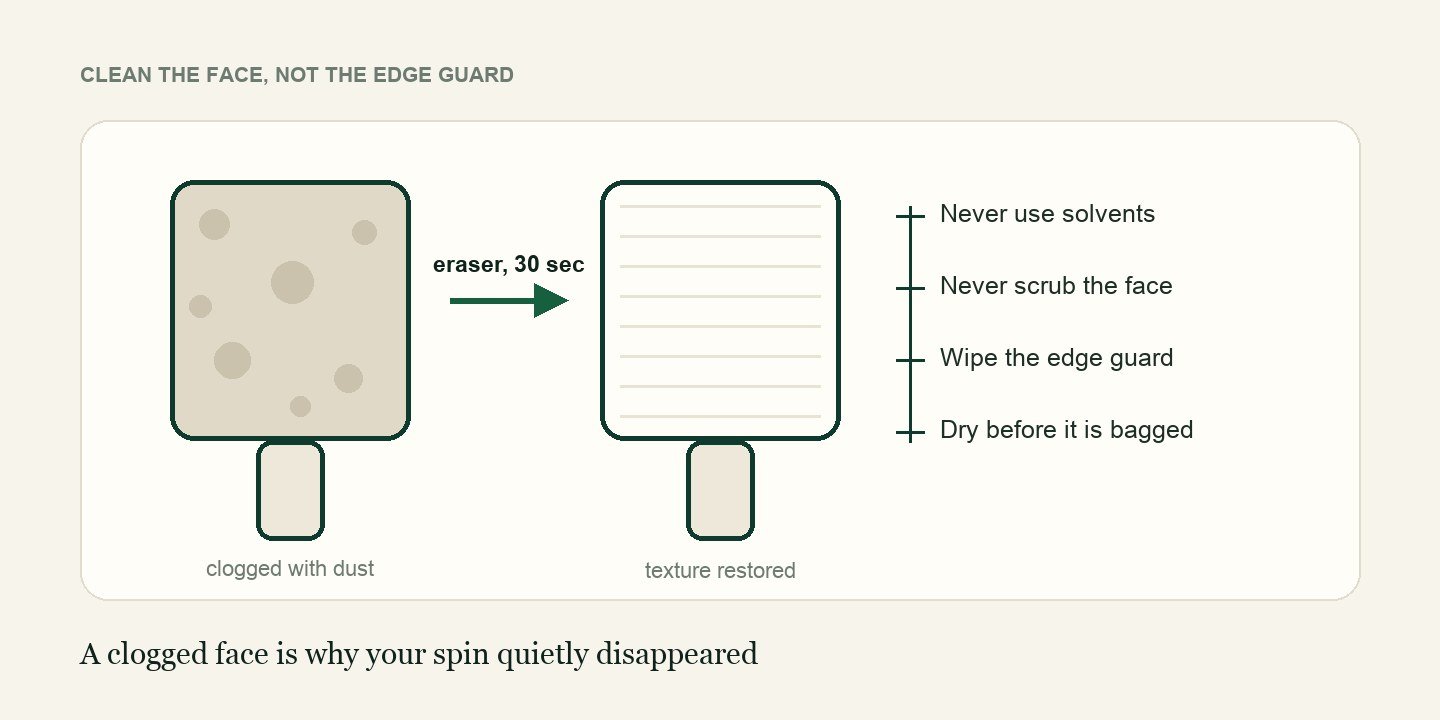
If your paddle has stopped biting the ball the way it used to, the problem is almost certainly not the paddle. It is the film of dust, sweat and ball residue sitting in the texture of the face. Cleaning it takes about thirty seconds and restores most of what you think you have lost.
Why a dirty face costs you spin
Spin comes from friction. A raw carbon or textured fiberglass face works because the surface grips the ball for a fraction longer, and that grip is what makes the ball rotate. Fill that texture with grit and skin oil and the face becomes effectively smooth. The paddle still looks fine; it just stops working.
This is the same mechanism we describe in what actually creates paddle spin. Face texture is doing the work, not the core — which is also why core thickness has nothing to do with it.
The right way to clean a raw carbon face
- Use a paddle eraser. It is a block of soft rubber that lifts residue out of the texture without polishing it flat. A CRBN paddle eraser (on Amazon) is the standard tool.
- Work in one direction, light pressure, a few passes. You are lifting, not scrubbing.
- Wipe the residue off with a dry microfibre cloth.
- Do it every two or three sessions, or whenever the ball starts sliding off the face.
What not to do
- No solvents. Alcohol, acetone and household sprays strip the resin that holds the texture together. That damage is permanent.
- No abrasive pads. Scouring the face polishes the peaks off the texture, which is exactly the surface you are trying to keep.
- No soaking. Water gets into the honeycomb core through the edge guard and it does not come out.
- Do not sand it. Surface roughness limits for sanctioned play are set by USA Pickleball, and roughening a face deliberately puts you outside them.
Painted and composite faces
Not every paddle has a raw carbon face. Painted fiberglass and composite faces — which is what most starter sets ship with, including the MTEN set (on Amazon) — should just be wiped with a damp cloth and dried. An eraser on a painted face will take the paint off.
The edge guard and the handle
- Wipe the edge guard separately with a damp cloth. It collects the most court grit and none of it belongs on the face.
- If the edge tape is lifting, replace it rather than gluing it — a loose edge guard lets moisture into the core.
- The handle is a different job. If the grip has gone slick, it is finished; see when to replace an overgrip.
Storage does half the work
Most paddle grime is picked up in the bag, not on the court. A sleeve or a padded compartment keeps the face away from shoes, keys and water bottles — which is the argument for a bag with a separate shoe compartment. Heat matters too: a paddle left in a hot car boot can delaminate, and no amount of cleaning fixes that.
If you are also adjusting how the paddle swings, do it after cleaning, not before — tungsten tape (on Amazon) sticks far better to a clean edge.
How to tell it worked
Hit ten topspin dinks before and ten after. If the ball is dropping shorter and rotating more after cleaning, the texture was the problem. If nothing changes, the face is genuinely worn out and no cleaning will bring it back — at which point start with grip size and what to buy next.