Can you play pickleball on a tennis court? Yes, and here is how
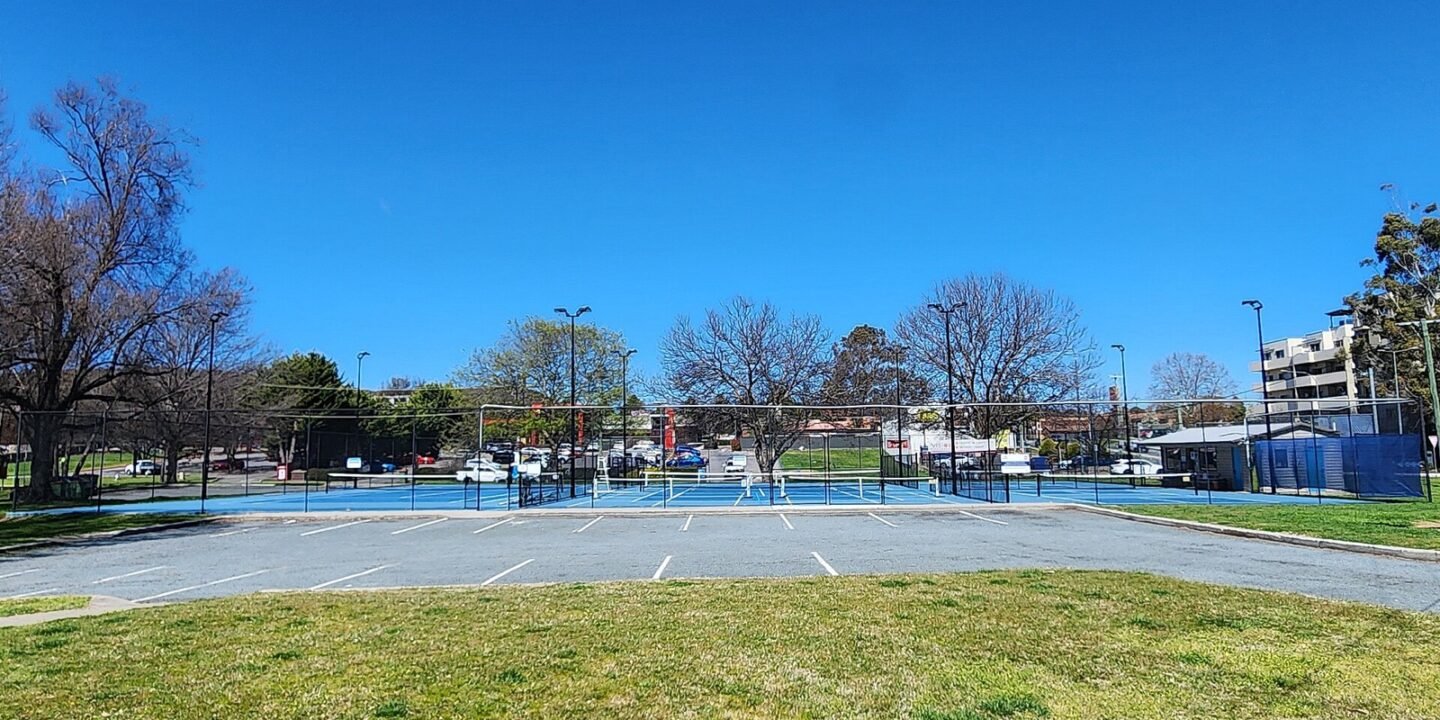
A shared court: tennis lines in one colour, pickleball lines in another, and a portable net that goes up in two minutes.
Photo: Shkuru Afshar · CC BY-SA 4.0 · source

Can you play pickleball on a tennis court? Yes. A tennis court is considerably larger than a pickleball court, and converting one is among the most common ways clubs and parks add pickleball capacity without building anything.
Disclosure: this page contains affiliate links to Amazon. If you buy through one we may earn a commission, at no extra cost to you. The commission is the same whichever product you choose, so it does not influence what we recommend.
There are three things to get right: the measurements, the net, and how you mark lines without damaging a surface that belongs to somebody else.
The numbers
| Pickleball | Tennis (doubles) | |
|---|---|---|
| Playing area | 20 ft × 44 ft | 36 ft × 78 ft |
| Recommended total space | 30 ft × 60 ft | 60 ft × 120 ft |
| Net at posts | 36 in | 36 in |
| Net at centre | 34 in | 36 in |
| Non-volley zone | 7 ft from net | — |
So one tennis court comfortably holds one pickleball court with generous run-off, or four laid out two by two if you are marking the surface and using portable nets. Four is the standard recreational conversion. Full court specifications are on the court dimensions page.
The net problem
This is the one real compromise. A pickleball net is 36 inches at the posts and drops to 34 inches at the centre. A tennis net is 36 inches at the posts and, when correctly strapped down, also 36 at the centre.
Two inches sounds trivial. In practice it is the difference between a drive down the middle clearing and clipping the tape, and it makes cross-court dinking meaningfully harder, since the middle of the net is exactly where the soft game lives. Precise measurements are on the net height page.
Your options, best first
- Portable pickleball nets. Around $100 to $200, set up in two minutes, correct height. This is what any regular group should do, and it is what lets you fit four courts on one tennis court.
- Loosen the centre strap. If you are using the tennis net, releasing the strap lets the middle sag closer to 34 inches. Crude, free, and reversible — but check whether the facility minds.
- Play it as-is. Perfectly fine for a casual game. Just know that a net two inches high in the middle is why your drops keep hitting the tape.
Playing across a tennis court
If you cannot bring portable nets, playing one pickleball court across the middle of the tennis court, using the tennis net, is the standard improvisation. Measure 22 feet either side of the net for the baselines and 10 feet either side of the centre line for the sidelines, and mark the kitchen 7 feet from the net on each side.
The tennis service line sits 21 feet from the net, so it is nearly — but not quite — your baseline. One foot matters more than you would expect on drives, so mark the real line rather than borrowing it.
Marking lines without wrecking the court
The rule that matters: never use anything with aggressive adhesive. Duct tape lifts the surface coating when removed and will get your group banned.
- Blue painter’s tape. The default for temporary lines. Cheap, visible, lifts cleanly. Lasts a session or two outdoors.
- Vinyl court tape. Purpose-made, more durable, more expensive. Good for a group that plays the same courts weekly.
- Sidewalk chalk. Free and entirely harmless. Survives until it rains or the court gets busy.
- Temporary line markers. Weighted rubber or plastic strips that lie flat. No adhesive, reusable, though they can move if kicked.
- Permanent paint. Facility decision, not a player one. Shared courts normally use a contrasting colour so the two sets of lines are distinguishable at speed.
Laying out four courts
For a two-by-two layout on a standard tennis court, mark two 20 × 44 courts on each half, running perpendicular to the tennis net. You will have modest run-off between them — tighter than ideal, which is why converted courts feel cramped on wide balls. It is the accepted trade for quadrupling capacity.
Court etiquette on shared surfaces
Shared-use courts are where most pickleball-versus-tennis friction happens, and almost all of it is avoidable.
- Check posted rules first. Many facilities reserve specific courts or hours for each sport.
- Remove temporary tape when you leave, every time. This single habit does more for pickleball’s standing at a facility than anything else.
- If tennis players are waiting and you are on a shared court, treat the posted rotation as binding.
- Do not re-strap or unstrap a tennis net without checking. It is the facility’s equipment.
- Noise carries. Pickleball is louder than tennis, and adjacent-court complaints are the usual reason access gets restricted.
Is it worth it?
For a regular group, yes — buy a portable net and a roll of painter’s tape and you have four courts wherever there is an unused tennis court. The only genuine compromise is the net height, and only if you are using the tennis net rather than your own.
Once you are set up, the soft game is where converted courts feel most different, because the higher centre net changes dinking more than it changes anything else.
Where to look
You can browse portable pickleball nets on Amazon. A regulation 22-foot net is what solves the height problem described above.
Common questions
Can you play pickleball on a tennis court?
Yes. A pickleball court is 20 by 44 feet and a tennis court is 36 by 78 feet, so a tennis court fits one pickleball court with room to spare, or four if the surface is properly marked. The only real complication is the net, which sits about 3 inches too high at the centre for pickleball.
How many pickleball courts fit on one tennis court?
Four, laid out two by two, if you mark the surface and use portable nets. The standard recreational conversion is four courts on one tennis court. If you are using the existing tennis net rather than portable ones, you get one pickleball court played across the middle.
Is the tennis net too high for pickleball?
Slightly. A tennis net is 36 inches at the posts and 36 at the centre when properly strapped, while a pickleball net should be 36 at the posts and 34 in the middle. That 2-inch difference at the centre is playable for casual games, but it penalises drives down the middle and changes dinking noticeably.
How do you mark pickleball lines on a tennis court?
For temporary marking use painter's tape, vinyl court tape or chalk, none of which damage the surface. Blue painter's tape is the usual choice because it lifts cleanly. For permanent shared courts, facilities paint pickleball lines in a contrasting colour, typically to a different standard than the tennis lines so players can tell them apart at a glance. Never use duct tape on a court surface.
Can you use the tennis lines for pickleball?
Not directly — no combination of tennis lines produces a 20 by 44 foot court. The tennis service boxes are close in one dimension but wrong in the other. You need your own lines, though the tennis baseline and centre mark are useful reference points for laying them out.