Portable pickleball net: what to check before you buy
A portable pickleball net turns a driveway, a car park or a school hall into a court in about ten minutes. It is also the single easiest piece of equipment to buy badly, because the specs that matter are not the ones listed first.
The dimensions that matter
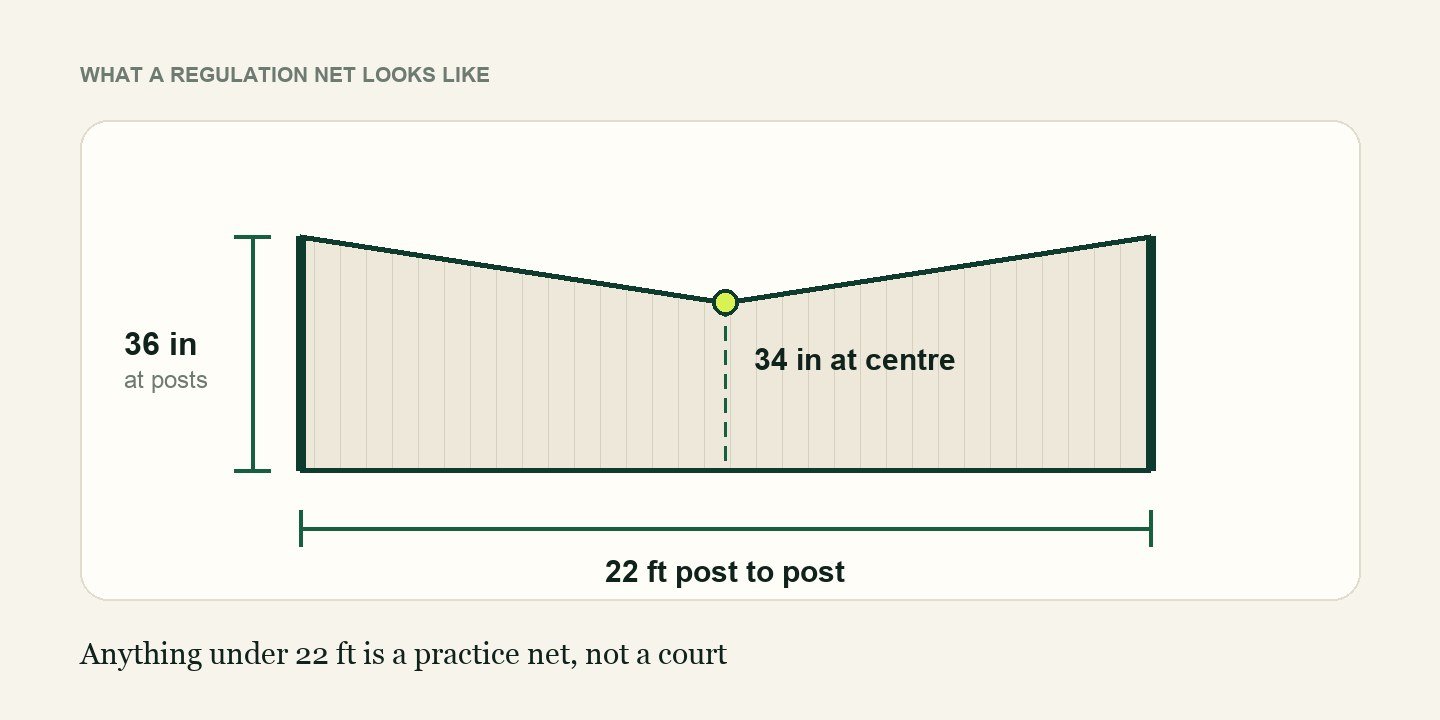
A regulation net is 22 feet wide, 36 inches high at the posts and 34 inches at the centre. That sag in the middle is deliberate and it changes how the game plays — balls that clear the centre would not clear the ends.
Plenty of portable nets are sold at 10 or 15 feet wide. They are fine for solo drilling, but you cannot play a real game on one, and practising on a narrow net teaches you the wrong angles. If you want the full picture on court geometry, we covered net height and court dimensions separately.
What to check before you buy
- Actual width. Look for 22 ft. Anything less is a practice net, however it is marketed.
- Centre height. A good net has a centre strap or tensioner to set 34 inches. Without one it either sags too much or is pulled flat.
- Frame material. Steel is heavier but survives wind. Fibreglass poles are lighter and snap sooner.
- Base stability. Wide feet matter far more outdoors than net quality does. A net that blows over is useless.
- Setup time. Look for a stated time. Over fifteen minutes and you will stop bothering.
- A carry bag. Not a luxury — a loose net and eight poles in a car boot is how parts go missing.
Nets worth considering
The Zdgao portable net (on Amazon) comes with balls and a carry bag and is aimed squarely at driveway play. The Boulder portable net (on Amazon) uses extendable poles and adjusts to other net heights, so it doubles for badminton if you have mixed users at home.
If what you actually want is solo practice rather than a game, a rebounder is the better buy. The Fostoy rebounder (on Amazon) has an adjustable angle and a wheel, and it will do more for your third shot drop than a full net will. The rest are in the accessories section of the store.
Marking out the court
The net is only half of it. A pickleball court is 20 ft by 44 ft, with the non-volley zone extending 7 ft from the net on each side. Chalk works on asphalt; removable line tape works on gym floors. If you are converting an existing court, our guide to playing on a tennis court covers how the lines map across.
Setting it up so it plays properly
- Set the posts to 22 ft apart before you tension anything.
- Tension the top cord until the posts are just vertical — over-tensioning bends them permanently.
- Set the centre strap last, to 34 inches, measured from the ground to the top of the net.
- On grass or gravel, peg or weight the feet. On a windy day, weight them regardless.
- Take it down after each session. UV and rain kill portable nets far faster than play does.
Is it worth it
If you have a driveway or a garage and you play more than once a week, yes — the amount of practice you get from a net twenty steps from your door is not comparable to booking a court. If you only ever play at a club with permanent nets, it is a purchase you will use twice.
Official net specifications for sanctioned play come from USA Pickleball. If you are setting up a home court from scratch, start with the court dimensions guide and the accessories worth buying.