Pickleball paddle grip size: how to measure yours in 10 seconds
Grip size is the spec people ignore and then blame for everything else. A paddle that is a quarter inch too big will slide in your hand on a hard drive; one that is too small makes you squeeze harder than you should, and that tension travels straight up into your elbow. It costs nothing to get right, and it is the one measurement you can take at home in about ten seconds.
What pickleball paddle grip size actually measures
Grip size is the circumference of the paddle handle, measured in inches. Almost every paddle sold sits between 4 and 4 1/2 inches, and the vast majority cluster around 4 1/8 to 4 1/4. That is a narrow band, which is why so many players assume the number does not matter. It does — a quarter inch is the difference between the handle sitting in your fingers and sitting in your palm.
This is a different spec from paddle weight and from what the face is made of. Weight changes how the paddle swings. The face changes how it grips the ball. Grip size only changes how securely you hold it — but everything else depends on that.
How to measure your grip size at home
The ruler method
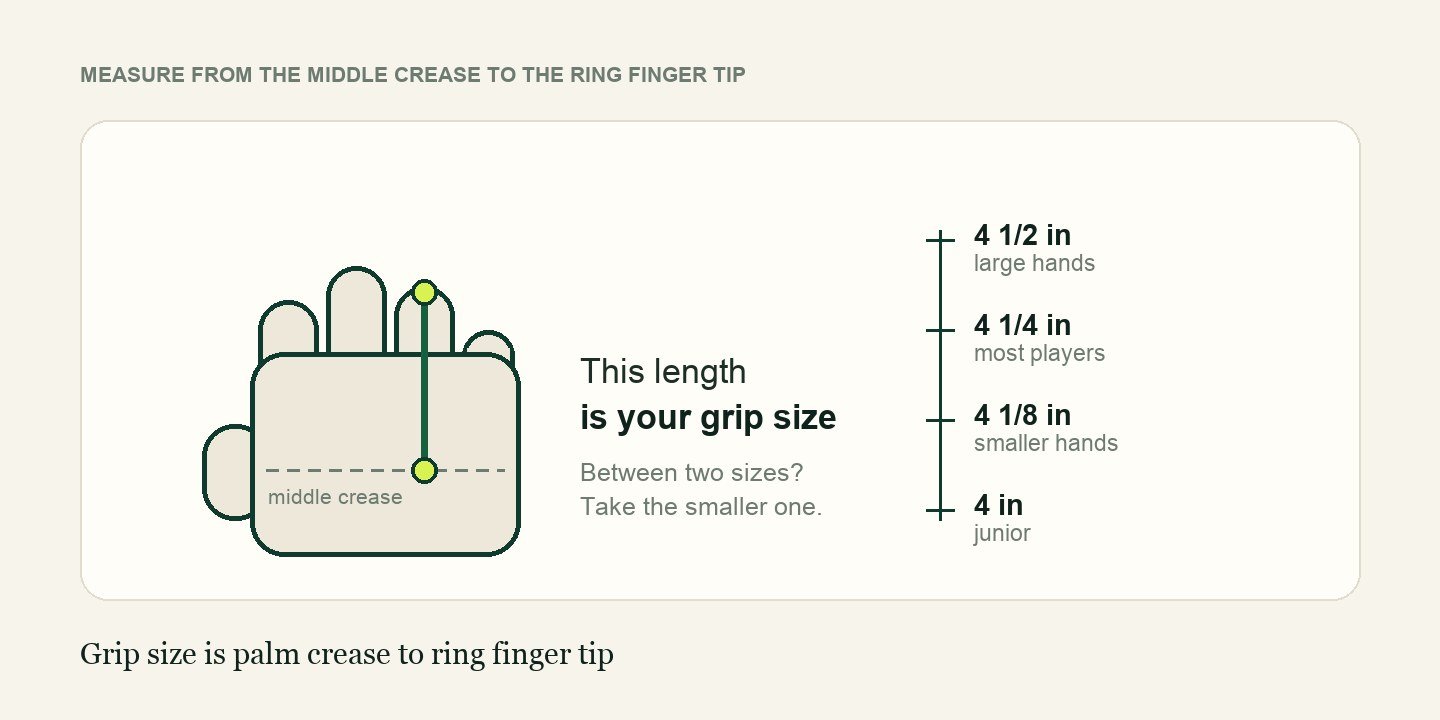
Open your dominant hand, palm up, fingers together. Find the middle crease that runs across your palm. Measure from that crease to the tip of your ring finger. That measurement in inches is your grip size, near enough. Most adults land between 4 and 4 1/2 inches.
The index finger test
If you already have a paddle, hold it in a normal continental grip. Slide the index finger of your other hand into the gap between your fingertips and the base of your thumb. If it fits snugly, the grip is right. If there is room to spare, the grip is too big. If the finger will not fit at all, it is too small.
What each size feels like on court
- 4 to 4 1/8 in — more wrist action, easier to generate spin, and quicker hand speed at the net. The trade-off is you have to hold on harder during drives.
- 4 1/4 in — the middle of the road, and what most stock paddles ship with. If you genuinely do not know, this is the safe default.
- 4 1/2 in — more stability and less wrist, which suits players coming from tennis who want a locked-in feel. Harder to roll the wrist for topspin.
When in doubt, size down
This is the one rule worth memorising: you can always add grip size, but you can never take it away. An overgrip adds roughly 1/16 of an inch per wrap. Two wraps takes a 4 1/8 handle to about 4 1/4. Going the other way means stripping the factory grip off and shaving the handle, which is fiddly and usually ruins resale value.
So if you are between sizes, buy the smaller one and build it up. A three-pack of Tourna Grip costs less than a takeaway and lets you dial the handle in over a couple of sessions. We keep it in the accessories section of the store for that reason.
Paddles that make sizing easy
Starter sets tend to come in one grip size only, which is fine when you are learning but limits you later. The Selkirk SLK Neo set (on Amazon) is a reasonable two-paddle starting point. If you have already worked out that you want a thinner handle you can build up, the Vatic Pro Prism 16mm (on Amazon) is the more serious option. Browse the rest in the paddles section of the store.
How to re-grip a paddle in five minutes
- Leave the original grip on. You are adding, not replacing.
- Start at the butt of the handle and wrap upward at a slight angle, overlapping each turn by about a third.
- Keep light, even tension — pulling hard stretches the tape and it will unravel within a week.
- Finish below the paddle face and secure it with the tape that came in the pack.
- Re-wrap when the surface stops feeling tacky, which for most players is every four to six weeks.
Common mistakes
- Buying by paddle model instead of hand size. Two paddles from the same brand can ship with different handles.
- Sizing up because the paddle feels small in the shop. A dry hand in a shop is not a sweaty hand in the third game.
- Ignoring handle length. Grip circumference and handle length are separate. Two-handed backhand players need 5 1/2 inches or more of handle regardless of circumference.
The short version
Measure palm crease to ring finger tip. If you land between two sizes, take the smaller and add an overgrip. Check the fit with the index finger test every few months — hands change, and so does the amount you sweat.
Equipment specifications for sanctioned play are set by USA Pickleball, the sport’s national governing body, and there is a decent general overview of the game on Wikipedia if you are new to it. For the rest of the kit, start with our guide to paddles for beginners and the accessories worth buying.