How to choose a pickleball paddle: every spec that matters
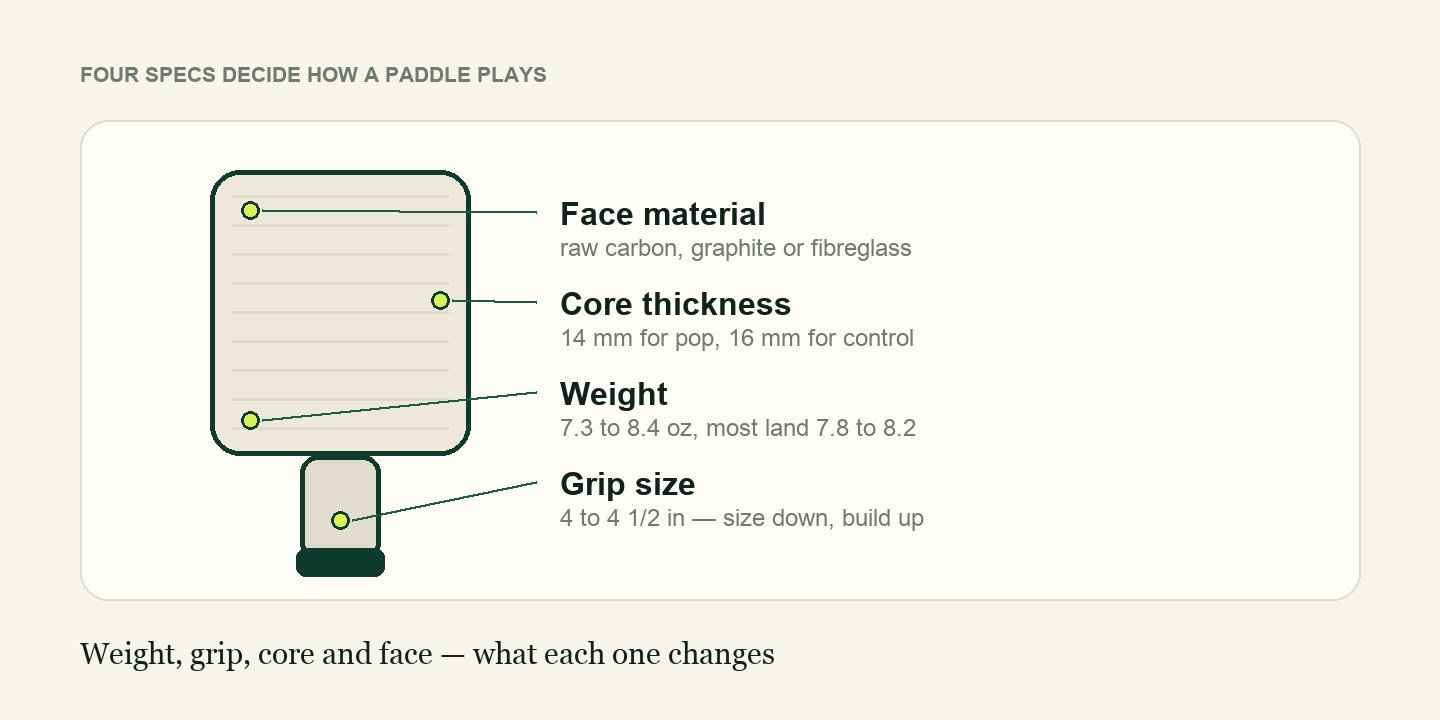
A pickleball paddle is four decisions: how heavy it is, how thick the core is, what the face is made of, and whether the grip fits your hand. Every marketing claim on a paddle box reduces to one of those four, and two of them — weight and grip — matter far more than the ones brands spend their advertising on.
Disclosure: this page contains affiliate links to Amazon. If you buy through one we may earn a commission, at no extra cost to you. The commission is the same whichever product you choose, so it does not influence what we recommend.
Here is what each spec changes, and where the money stops buying you anything.
How much should a pickleball paddle weigh?
Paddles run from about 7.3 to 8.4 ounces. Lighter paddles are quicker in hand-battles at the kitchen and easier on the elbow. Heavier paddles are more stable when you get jammed and hit harder for the same swing.
The trap is going too light. Under about 7.6 ounces, a paddle gets pushed around when someone drives at you, and you compensate by swinging harder — which is exactly how people end up with a sore elbow. Most players land between 7.8 and 8.2 ounces. If you are unsure, buy in that band and add lead tape later; you can make a paddle heavier, never lighter.
Pickleball paddle grip size
This is the spec that is genuinely worth measuring, and the one most people ignore.
Measure from the middle crease of your palm to the tip of your ring finger. That number in inches is roughly your grip circumference: about 4 inches for most women, 4 ⅛ to 4 ¼ for most men. Too small and you squeeze to keep the face stable, which kills touch and is the fastest route to tennis elbow. Too large and you cannot get wrist snap on a roll.
An overgrip adds about 1/16 of an inch, so buy slightly small rather than slightly large — you can build up, but you cannot shave down.
14mm vs 16mm: what core thickness does
The polymer honeycomb core is what the ball actually hits. Thickness changes how much it flexes.
- 14mm (and 13mm) — stiffer, less dwell time, more pop. Rewards a full swing, punishes a soft one. This is the driver’s core.
- 16mm — more flex, more dwell, more forgiveness on off-centre contact. Soft resets and drops land shorter with less effort.
If your game plan involves getting to the kitchen line and staying there — which is every pickleball game plan — 16mm is the more useful core, and it is what almost every control paddle uses.
Face materials: carbon fibre, graphite, fibreglass
- Raw carbon fibre (T700, toray) — the current default. The unpainted texture grabs the ball, which is where the spin claims come from. Consistent, moderate power.
- Graphite — light, crisp, predictable. The old standard; still fine.
- Fibreglass — more flex on impact, so more power and a smaller sweet spot. Cheap paddles use it because it hits hard out of the box.
Raw carbon is genuinely better at spin than fibreglass, and the texture wears down over roughly a season of heavy play. That is the honest version of the spin marketing.
Shape: elongated, standard, widebody
Total length plus width cannot exceed 24 inches, and length cannot exceed 17. Brands spend that budget differently.
- Standard (about 16 × 8 in) — the biggest sweet spot and the most forgiving. Start here.
- Elongated (16.5 × 7.5 in) — more reach and leverage on drives, a narrower sweet spot, harder to defend with.
- Widebody (15.5 × 8.25 in) — maximum forgiveness, least reach.
What more money actually buys
Between $60 and $130 you get a real thermoformed or cold-pressed carbon paddle from an established brand, and that is where the value is. Above about $180 you are buying edge-foam construction, tighter weight tolerances and a pro’s name. Those are real differences, but they are worth less to a 3.0 player than a grip that fits.
Whatever you buy, check it is on the USA Pickleball approved list if you ever plan to enter a tournament.
Where to go next
For specific models in the beginner price band, see pickleball paddles for beginners. For the other half of your gear budget — the half that prevents injuries — see best pickleball shoes.
More gear guides
- Pickleball paddles for beginners — What to buy first, which specs matter at 2.5 to 3.5, and how to spend under $120 well.
- Best pickleball shoes — Why court shoes beat running shoes, and the injury case for making the switch.
- Pickleball paddle grip size — How to measure your hand in ten seconds, and why you should always size down and build up.
- How to clean a pickleball paddle — A clogged face is usually why your spin disappeared, and the four things that damage it for good.
Where to look
You can browse pickleball paddles on Amazon. Shop on core thickness, shape, weight and face material — the four specs above.