How long do pickleball balls last, and when to bin them
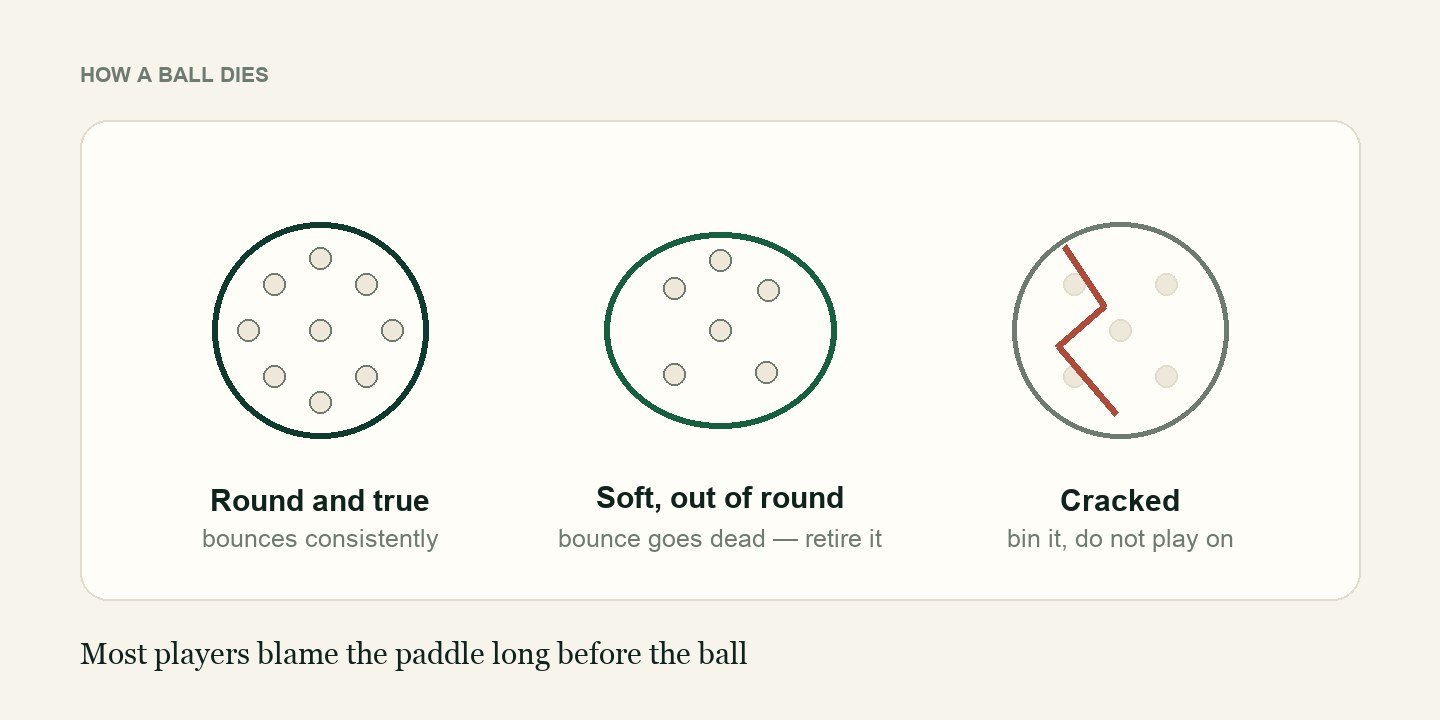
There is no hour count printed on a pickleball. They fail in two different ways — they crack, or they quietly go soft — and the second one is the reason so many rec games feel inconsistent without anyone knowing why.
The short answer
- Outdoor balls, competitive play: often 3 to 10 hours of hitting. Hard drives and cold weather shorten this a lot.
- Outdoor balls, casual rec play: commonly a few weeks of regular sessions before the bounce goes.
- Indoor balls: usually last considerably longer, because the plastic is softer and gym floors are kinder than concrete.
Treat those as rough bands, not promises. A ball that spends its life in a bag in a cold car will not last as long as the same ball played indoors in summer.
The two ways balls die
Cracking is obvious. Hard outdoor plastic goes brittle, and one clean drive splits it. You will usually hear it before you see it — the sound goes flat and rattly. A cracked ball is done: it is out of round and it will not bounce true.
Going soft is the sneaky one. The ball stays intact but the plastic fatigues, so it deforms slightly on every impact and never quite returns. The bounce drops, the ball dies on your dinks, and drives stop carrying. Most players blame their paddle or their form long before they blame the ball.
The 30-second test
- Drop test. Drop from waist height onto a hard surface next to a new ball. If the old one bounces noticeably lower, retire it.
- Squeeze test. Press between thumb and forefinger. A fresh outdoor ball barely gives. A tired one flexes.
- Sound test. A good ball has a sharp click off the paddle. A dead one thuds.
- Spin test. Spin it on a table. Out-of-round balls wobble.
What shortens their life
- Cold. Below roughly 10°C outdoor plastic gets brittle and cracks far sooner. Do not leave balls in the car overnight in winter.
- Rough surfaces. Unfinished concrete abrades the surface and rounds the hole edges.
- Hard hitting. A game full of drives and overheads is much harder on balls than a dinking session.
- Being stood on. The single most common instant death. Watch where you put your feet.
Buying in the right quantity
Because they are consumable, buying in threes is false economy. Bulk packs work out far cheaper per ball, and having spares means nobody plays on a cracked one because it is the only one in the bag.
For outdoor play, the Selkirk Pro S1 (on Amazon) comes in 4, 12 and 100 packs, and the Vulcan VPRO Flight (on Amazon) goes up to 100 as well. The Magicorange bulk packs (on Amazon) are the cheap-per-ball option for clubs that get through them.
Indoors, the Franklin X-26 (on Amazon) is the standard. If you split your time, the cyclotron six-pack (on Amazon) covers both. The full range is in the balls section of the store.
Making them last a bit longer
- Store them indoors at room temperature, not in a car boot.
- Rotate a set of three rather than hammering one ball flat.
- Let cold balls warm up before you play with them.
- Retire balls to a practice bucket rather than keeping them in the game bag — a ball hopper (on Amazon) is useful for exactly this.
Do not play on a cracked ball
Beyond the inconsistent bounce, a cracked ball changes flight unpredictably, which is how people end up lunging awkwardly. It is a two-dollar part. Bin it.
If you are unsure which ball you should be using in the first place, we compared indoor and outdoor balls in detail, and ball specifications for sanctioned play are set by USA Pickleball.